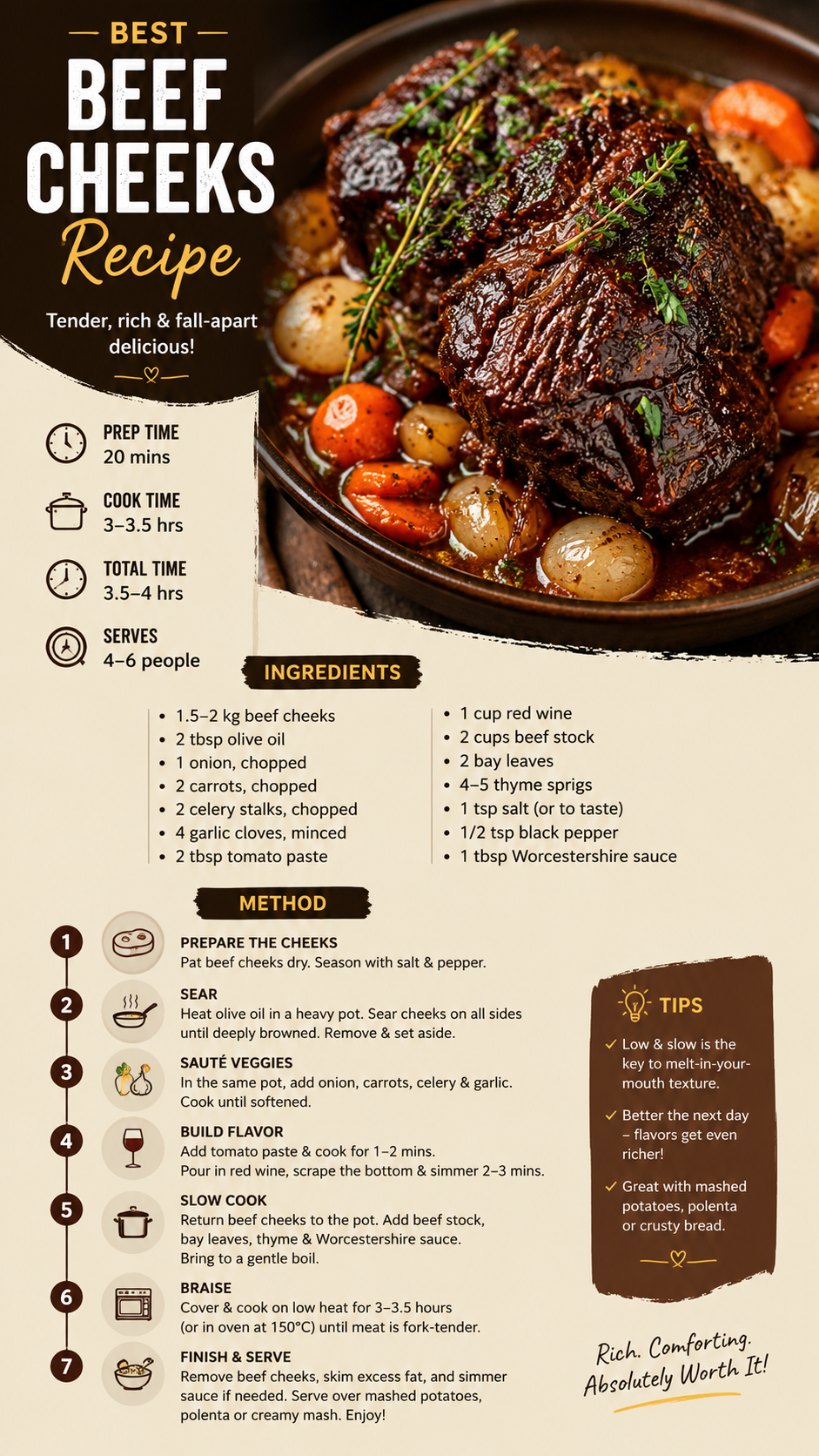
You’ve made pot roast. You’ve done short ribs. But have you tried beef cheeks?
Because once you do, a lot of other cuts start feeling like second place.
Beef cheeks are one of those cuts that most people walk right past at the butcher. And that is a huge mistake. They’re rich, deeply marbled, and when braised low and slow, they turn into something so tender it almost doesn’t feel real.
We’re talking pull-apart, melt-on-your-tongue, need-to-close-your-eyes-for-a-second tender. 😌
This isn’t a complicated recipe. But it does take time. And that time? Completely worth it.
What You’ll Need
For the Beef Cheeks:
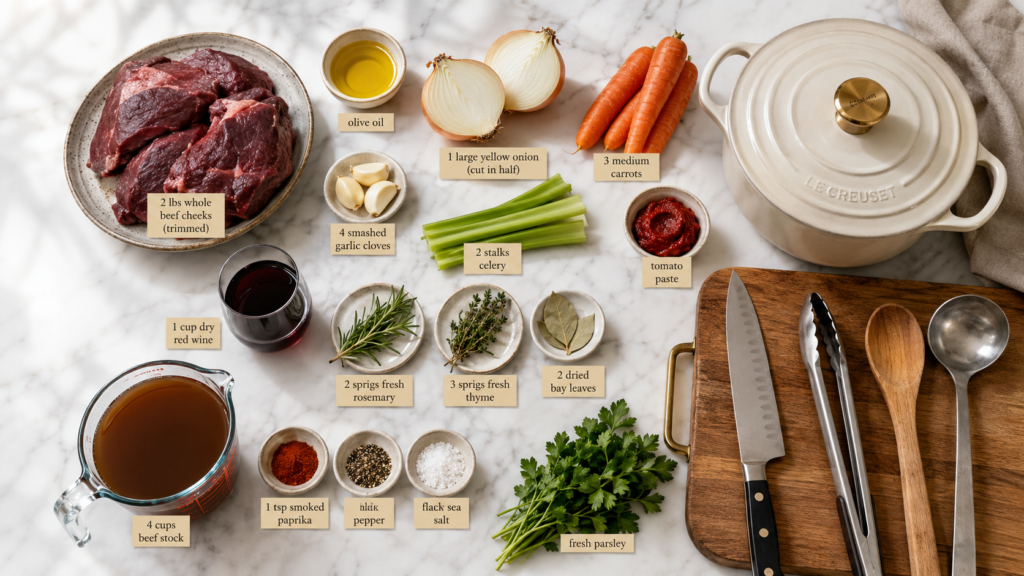
- 2 lbs (900g) beef cheeks, trimmed of excess fat and sinew
- 2 tbsp olive oil
- 1 large yellow onion, roughly chopped
- 3 medium carrots, roughly chopped
- 4 garlic cloves, smashed
- 2 stalks celery, roughly chopped
- 2 tbsp tomato paste
- 1 cup (240ml) dry red wine (something you’d actually drink, like a Shiraz or Merlot)
- 2 cups (480ml) beef stock
- 2 sprigs fresh rosemary
- 3 sprigs fresh thyme
- 2 bay leaves
- 1 tsp smoked paprika
- Salt and black pepper, to taste
For Serving (Optional but Recommended):
- Creamy mashed potatoes or soft polenta
- Fresh parsley, chopped
- Flaky sea salt, for finishing
Tools You’ll Need
- Large Dutch oven or heavy-bottomed oven-safe pot with a lid
- Sharp chef’s knife
- Cutting board
- Wooden spoon or spatula
- Tongs
- Small bowl (for the tomato paste)
- Ladle
- Serving plates or shallow bowls
Pro Tips
These are the things that make the difference between good and really good.
- Trim it properly. Beef cheeks have a tough silver membrane on the outside. Ask your butcher to remove it, or take 5 minutes to do it yourself. Leave the fat, remove the sinew. The fat renders down beautifully. The sinew does not.
- Don’t rush the sear. Pat your cheeks completely dry before they hit the pan and get it properly hot before adding the oil. A deep brown crust on the outside = flavor in the final sauce. If the pan isn’t hot enough, you’ll steam them instead of sear them.
- Use wine you’d actually drink. Cheap cooking wine makes cheap-tasting food. It doesn’t need to be expensive, just something drinkable. The alcohol cooks off. The flavor stays.
- Go low and slow. The collagen in beef cheeks needs time at a low temperature to break down into gelatin. That’s what gives you that silky, sticky sauce. Don’t try to rush it at a higher temp. 300°F (150°C) for 3 to 3.5 hours is the sweet spot.
- Rest before serving. Pull them out of the oven and let them sit in the braising liquid for at least 10 minutes. They’ll absorb even more flavor and be easier to plate without falling apart completely.
Substitutions and Variations
No beef cheeks? Short ribs or chuck roast work well here. The cook time stays about the same. The texture will be slightly different, but still delicious.
No red wine? Swap it for extra beef stock with a splash of balsamic vinegar. You’ll still get depth and acidity.
Different herbs? Sage works beautifully in place of rosemary. Or skip both and go heavy on thyme.
Want it spicier? Add a pinch of chili flakes when you’re cooking the tomato paste. It adds warmth without making it a spicy dish.
Gluten-free? This recipe is naturally gluten-free as written. Just double-check your stock labels.
Make Ahead Tips
This recipe is made for making ahead.
The flavor actually deepens overnight, so braising the cheeks a day before you need them is genuinely a good idea, not just a time-saving one.
- Braise the cheeks, let them cool completely in the liquid, then refrigerate overnight in the Dutch oven (or transfer to an airtight container).
- When you reheat, do it gently on the stovetop over low heat, covered, for about 20 minutes. Add a splash of stock if the liquid has thickened too much.
- The fat will solidify on top when chilled. Skim it off before reheating for a cleaner sauce. Or leave it if you’re not fussed.
How to Make Braised Beef Cheeks
Step 1: Prep the Cheeks
Pat your beef cheeks completely dry with paper towels. Season generously on all sides with salt and black pepper. Don’t be shy with the seasoning here, this is a big piece of meat.
Step 2: Sear
Preheat your oven to 300°F (150°C).
Heat 2 tbsp of olive oil in your Dutch oven over high heat. Once it’s shimmering, add the beef cheeks in a single layer. Don’t move them.
Sear for 3 to 4 minutes per side until deeply browned. Work in batches if needed so you’re not crowding the pot.
Remove the cheeks and set aside on a plate.
Step 3: Build the Base
Reduce the heat to medium. In the same pot, add the onion, carrots, celery, and garlic. Cook for 5 to 6 minutes, stirring occasionally, until softened and starting to turn golden.
Add the tomato paste and stir it into the vegetables. Cook for 2 minutes so it darkens slightly and loses that raw edge.
Step 4: Deglaze
Pour in the red wine and scrape up all the browned bits from the bottom of the pot with your wooden spoon. Those bits are pure flavor.
Let the wine bubble for 2 to 3 minutes to reduce slightly.
Step 5: Add Stock and Aromatics
Add the beef stock, rosemary, thyme, bay leaves, and smoked paprika. Stir everything together and bring to a simmer.
Nestle the seared beef cheeks back into the pot. They should be mostly submerged. If not, add a splash more stock.
Step 6: Braise
Cover with the lid and transfer to the oven. Cook for 3 to 3.5 hours, until the cheeks are completely tender and a fork slides through without any resistance.
Check on them once halfway through to make sure the liquid is gently simmering, not boiling.
Step 7: Finish the Sauce
Remove the cheeks carefully with tongs and set them aside. Discard the rosemary, thyme, and bay leaves.
If you want a thicker sauce, bring the liquid to a simmer on the stovetop for 10 to 15 minutes until it reduces and coats the back of a spoon. Taste and adjust with salt and pepper.
Step 8: Serve
Spoon the sauce over the cheeks on top of creamy mashed potatoes or polenta. Finish with a scatter of fresh parsley and a pinch of flaky sea salt.
Nutritional Breakdown (Per Serving, Approx.)
| Nutrient | Amount |
|---|---|
| Calories | ~480 kcal |
| Protein | ~42g |
| Fat | ~28g |
| Carbohydrates | ~8g |
| Fiber | ~1g |
| Sodium | ~520mg |
Note: Values will vary depending on trimming and exact ingredients used. Excludes serving sides.
Meal Pairing Suggestions
These braised beef cheeks are rich and deeply savory. They pair best with something that balances that intensity.
- Creamy mashed potatoes (the classic for a reason)
- Soft polenta with parmesan stirred in
- Roasted root vegetables like parsnips or turnips
- Simple green salad with a sharp vinaigrette to cut through the richness
- Crusty sourdough bread to mop up every last bit of sauce
For drinks, the same wine you used in the braise works well. A Shiraz, Merlot, or Cabernet Sauvignon are all great here.
Leftovers and Storage
Beef cheeks keep and reheat beautifully. In fact, many people think they taste even better the next day.
- Fridge: Store in an airtight container with the braising liquid for up to 4 days.
- Freezer: Freeze in portions with sauce for up to 3 months. Thaw overnight in the fridge before reheating.
- To reheat: Warm gently in a covered pot on the stovetop over low heat. Add a little stock or water if the sauce has thickened up too much.
They’re amazing shredded into tacos, on top of pasta, or stuffed into a crusty sandwich roll. Just saying. 👀
FAQ
Where do I buy beef cheeks? Your best bet is a local butcher. Some grocery stores carry them, but they’re not always stocked. Call ahead. If you can’t find them, ask your butcher to order them for you.
Do I have to use red wine? No. Extra beef stock with a splash of balsamic vinegar is a solid swap. The wine adds depth and a little acidity, but it’s not non-negotiable.
My sauce is thin. What do I do? Remove the cheeks and simmer the liquid on the stovetop for 10 to 15 minutes until it reduces to your liking. You can also stir in a small knob of cold butter at the end for extra gloss.
Can I make this in a slow cooker? Yes. Sear the cheeks and build the base in a skillet, then transfer everything to a slow cooker. Cook on low for 8 hours or high for 5 hours.
Can I make this in an Instant Pot? Yes. Sear on the sauté function, build the base, then pressure cook on high for 60 minutes with a natural release. The texture won’t be quite as silky as the oven method, but it’s still very good.
How do I know when they’re done? A fork or skewer should slide in and out with zero resistance. If there’s any toughness at all, put the lid back on and give them another 30 minutes.
Is this recipe kid-friendly? Yes. The wine alcohol cooks off completely during the braise, leaving just the flavor. Kids generally love how tender and mild this meat is.
Wrapping Up
If you’ve never cooked beef cheeks before, this is your sign to start.
There’s a reason this cut is on the menu at some of the best restaurants in the world. It’s because when you treat it right, it does something most other cuts just can’t do.
Low heat, time, a good wine, and a little patience. That’s all this takes.
And the payoff? You’ll be thinking about it for days.
Give this recipe a go and drop a comment below telling me how it turned out. Did you serve it over mash or polenta? Did you sneak a piece before it hit the plate? (No judgment.) 😄
Ask me anything in the comments. I read every single one.


