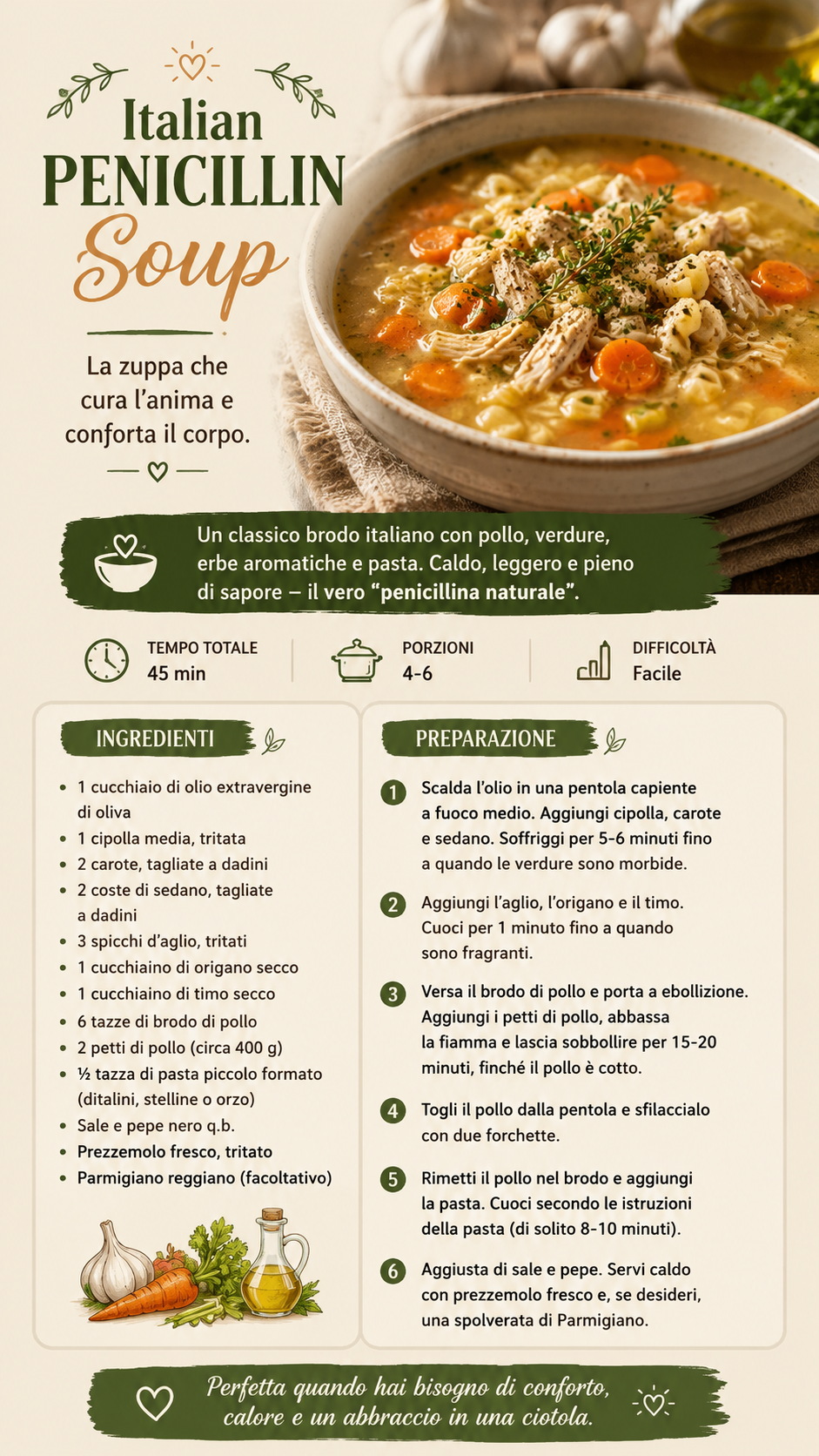
You know that feeling when you’re run-down, your throat is scratchy, and you just want someone to hand you a bowl of something warm?
This is that bowl.
Italian penicillin soup is basically a hug in liquid form. It’s built on rich chicken broth, tiny pasta, tender chicken, and a whole lot of parmesan. Simple ingredients. Deeply satisfying result.
And here’s the thing that surprises people: this soup has been used for centuries in Italian households as a remedy for sickness. Long before modern cold medicine, Italian grandmothers were ladling this into bowls. The name “penicillin” wasn’t even a joke to them.
Keep reading, because the pro tips section alone will change how you make this.
What You’ll Need
For the Broth
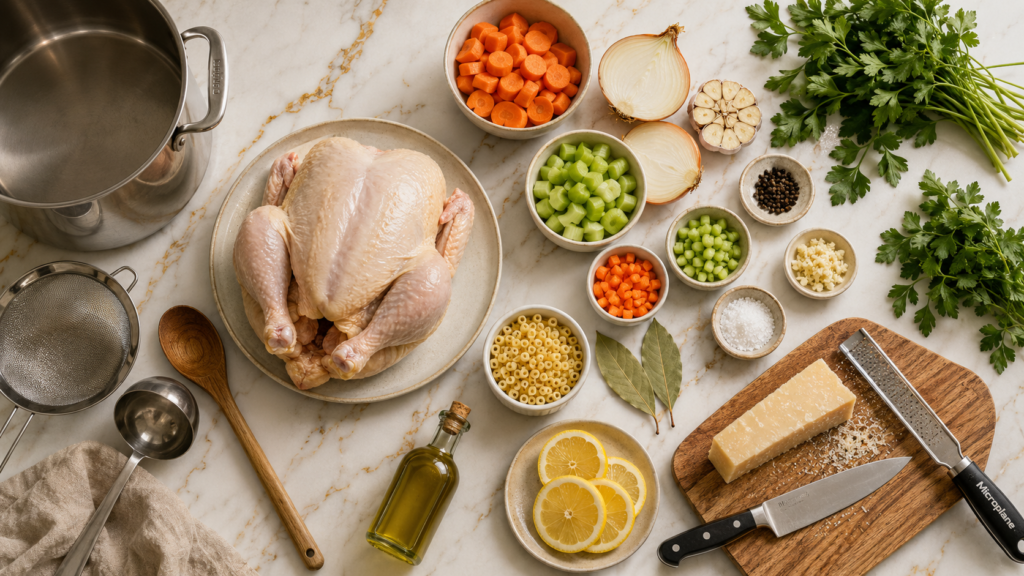
- 1 whole chicken (about 3.5–4 lbs), or 2 lbs bone-in, skin-on chicken thighs
- 3 medium carrots, peeled and roughly chopped
- 3 celery stalks, roughly chopped
- 1 large yellow onion, halved (no need to peel)
- 1 whole head of garlic, halved crosswise
- 1 bunch of fresh flat-leaf parsley (stems and all)
- 2 bay leaves
- 1 tsp whole black peppercorns
- 2 tsp sea salt (plus more to taste)
- 10–12 cups cold water
For the Soup
- 1 cup small pasta (ditalini, stelline, or acini de pepe work great)
- 2 medium carrots, diced small
- 2 celery stalks, diced small
- 3 cloves garlic, minced
- 1 tbsp extra virgin olive oil
- Salt and black pepper to taste
- Freshly grated parmesan (a generous amount — don’t be shy)
- Fresh flat-leaf parsley, chopped, for serving
- 1 lemon (just the juice — optional but recommended)
Tools You’ll Need
- Large stockpot (at least 7–8 quart)
- Fine mesh strainer or colander
- Cutting board and sharp knife
- Wooden spoon
- Ladle
- Large bowl (for straining)
- Microplane or box grater (for parmesan)
Pro Tips
These are the things that actually make a difference:
- Don’t skip the whole onion with the skin. The outer skin adds a beautiful golden color to your broth. It sounds strange, just trust it.
- Start with cold water. This is a little-known technique that pulls collagen and flavor out of the chicken slowly, giving you a much clearer, richer broth than starting with hot water.
- Don’t boil — simmer. A rolling boil makes cloudy, greasy broth. Low and slow (barely bubbling) gives you a clean, clear golden broth that actually tastes like something.
- Cook the pasta separately. If you cook it directly in the broth, it soaks up liquid and turns mushy by the next day. Cook it separately and add to each bowl as you serve.
- Add lemon right before serving. A small squeeze of fresh lemon brightens the whole bowl in a way that’s hard to explain until you try it.
How to Make Italian Penicillin Soup
Step 1: Build the Broth
Place the whole chicken (or chicken thighs) in your large stockpot.
Add the roughly chopped carrots, celery, halved onion, halved garlic head, parsley bunch, bay leaves, peppercorns, and salt.
Pour in the cold water until everything is covered by at least 2 inches.
Bring it to a gentle simmer over medium heat. Once it’s simmering, reduce the heat to low. You want just a few lazy bubbles at the surface.
Let it cook, uncovered, for 1.5 to 2 hours. The longer it goes, the deeper the flavor.
Skim any foam or fat that rises to the top during the first 20 minutes or so.
Step 2: Strain the Broth
Remove the chicken and set it aside to cool slightly.
Pour the broth through a fine mesh strainer into a large bowl. Discard the solids (they’ve already given everything they had).
You’ll have this gorgeous, golden broth. Taste it and adjust salt.
Step 3: Shred the Chicken
Once the chicken is cool enough to handle, pull the meat off the bones. Discard the skin and bones.
Shred the meat into bite-sized pieces. Set aside.
Step 4: Build the Soup
In the same stockpot, heat the olive oil over medium heat.
Add the diced carrots, celery, and minced garlic. Cook for about 5 minutes until slightly softened.
Pour the strained broth back in. Bring to a gentle simmer.
Add the shredded chicken back to the pot. Taste and adjust salt and pepper.
Step 5: Cook the Pasta (Separately)
Boil a small separate pot of salted water. Cook the pasta according to package directions until al dente. Drain and set aside.
Step 6: Serve
Ladle the hot soup into bowls. Add a scoop of pasta. Top with a generous pile of freshly grated parmesan and chopped parsley.
Squeeze a little fresh lemon over the top if you’re using it.
Eat immediately. Feel significantly better about everything.
Substitutions and Variations
| Swap | Why It Works |
|---|---|
| Rotisserie chicken | Cuts time in half — just use store-bought broth too |
| Gluten-free pasta | Works perfectly, no other changes needed |
| Zucchini noodles or rice | Great low-carb option |
| Spinach or kale | Stir in at the end for extra greens |
| Pecorino Romano instead of parmesan | Slightly saltier and sharper — equally delicious |
| Add a parmesan rind to the broth | This is an Italian secret — adds incredible depth |
If you want to make it more of a meal, throw in some white beans or chickpeas. They soak up the broth beautifully and make it filling enough that you don’t need anything on the side.
Make Ahead Tips
This soup was practically made to be prepped ahead of time.
The broth can be made up to 3 days in advance and stored in the fridge. It actually tastes better the next day once the fat solidifies on top (just skim it off and reheat).
The shredded chicken keeps in the fridge for 3–4 days.
The pasta should always be cooked fresh or stored separately. Never store it inside the soup.
Nutritional Breakdown (Per Serving, Approx.)
| Nutrient | Amount |
|---|---|
| Calories | ~280–320 kcal |
| Protein | 28–32g |
| Carbohydrates | 22–26g |
| Fat | 8–10g |
| Sodium | 600–750mg |
| Fiber | 2–3g |
Numbers vary based on pasta amount and chicken portions used.
This soup is genuinely high in protein, relatively low in fat, and packed with collagen from the long-simmered chicken bones. It’s comfort food that’s also actually good for you, which doesn’t happen all that often.
Meal Pairing Suggestions
- Crusty sourdough bread or a simple garlic bread for dipping
- A simple arugula salad with lemon and parmesan on the side
- Roasted vegetables if you want to round out the meal
- A glass of light white wine like Pinot Grigio if you’re making this for dinner on a weeknight (highly recommend)
Leftovers and Storage
Fridge: Store the broth and chicken together in an airtight container for up to 4 days. Keep the pasta in a separate container.
Freezer: The broth (without pasta) freezes beautifully for up to 3 months. Freeze in portions so you can pull out exactly what you need.
Reheating: Reheat gently on the stovetop over low heat. Don’t boil it again or the chicken will get tough. Cook a fresh batch of pasta when reheating.
One thing to know: the soup almost always tastes richer and more developed the next day. Leftovers are not a consolation prize here. They’re a reward. 🙌
FAQ
Can I use chicken breasts instead of a whole chicken?
You can, but the broth won’t be nearly as rich. Bone-in, skin-on pieces are what give this soup its depth. If you use breasts, add a store-bought chicken stock instead of plain water to compensate.
My broth looks cloudy. Did I mess it up?
Probably just boiled it a little too hard. It still tastes great, it just looks less restaurant-pretty. Next time, keep it at a very gentle simmer. No harm done.
Can I make this in a slow cooker?
Yes! Add everything for the broth to the slow cooker and cook on low for 6–8 hours. Then strain, shred, and continue from Step 4. It works really well.
Is this the same as Jewish penicillin (chicken soup)?
Similar concept, different seasoning profile. Jewish chicken soup often uses dill, while Italian penicillin leans on parsley, garlic, and parmesan. Both are incredible. Both will make you feel better. 😄
How much parmesan is too much parmesan?
More than you think. Less than you want. There is no wrong answer here.
Can I add other vegetables?
Absolutely. Diced zucchini, peas, or even a small diced potato work great. Add them in Step 4 when you’re building the soup and let them cook until tender.
Wrapping Up
This soup doesn’t need a fancy occasion or a specific reason to make it.
Make it when you’re under the weather. Make it on a cold Sunday when you don’t want to leave the house. Make it because it smells incredible simmering on the stove and fills up the whole kitchen.
The broth alone is worth the 2 hours. And once you taste it from scratch, you’ll never reach for a can again.
Give it a shot this week and let me know in the comments how it turned out. Any tweaks you made, any questions you have, any moments where you ate three bowls and had no regrets — I want to hear all of it. 🍋


