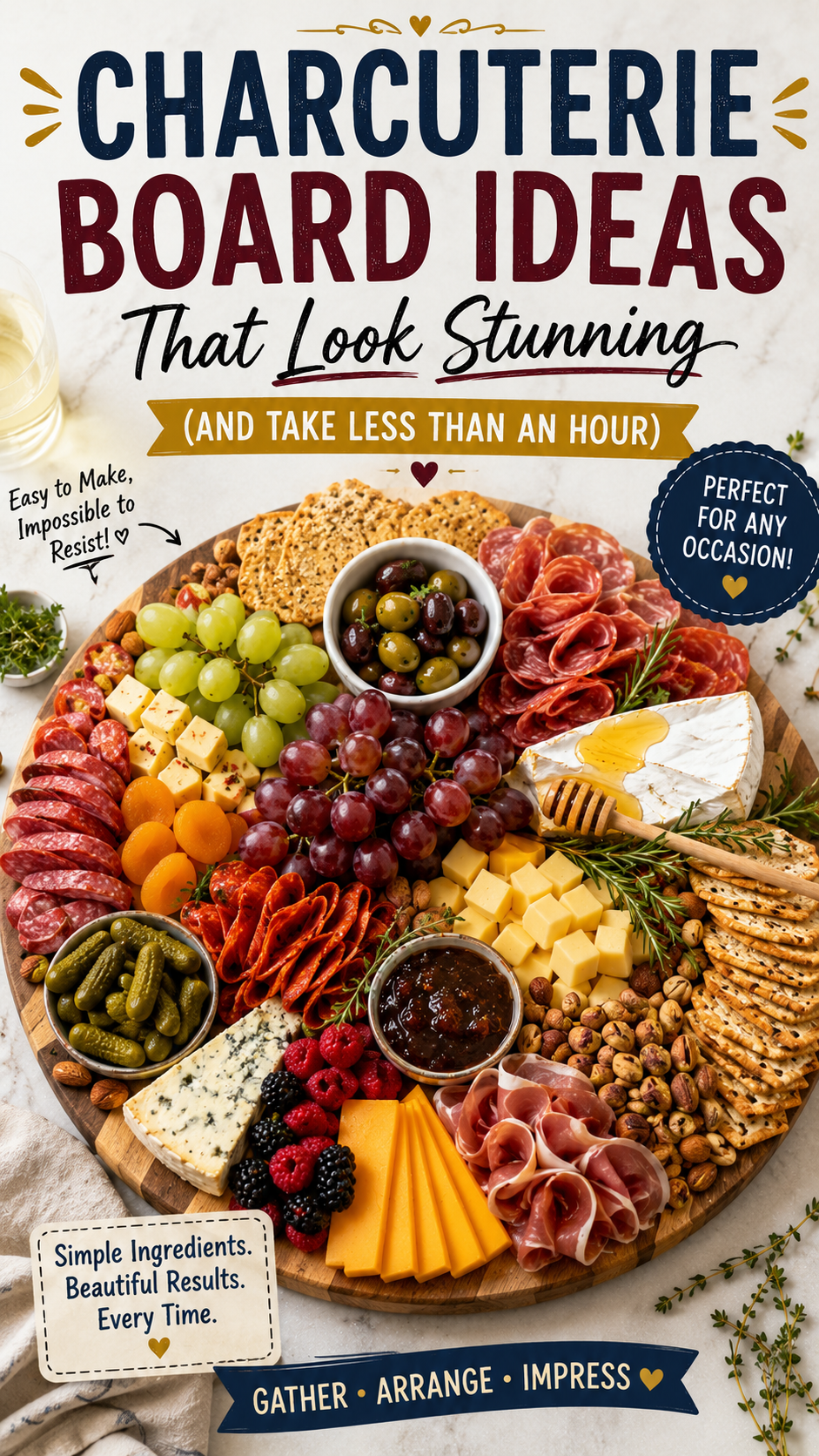
No culinary degree required. No stress. Just a board that makes people go “wait, YOU made this?”
Here’s the thing about charcuterie boards that nobody tells you upfront: there’s no real recipe.
No exact measurements. No technique you have to master. No cooking involved at all, actually.
You just… put beautiful things together on a board and call it a day.
And yet somehow, every time one lands on a table, people lose their minds over it. Guests photograph it before touching it. Someone always asks “how long did this take you?” And you’ll smile and say “oh, a little while” when really it was 45 minutes while a podcast played in the background.
That’s the whole game. And once you know how to play it, you’ll never stress about entertaining again.
What You’ll Need
Serves 6–10 as an appetizer | Prep: 30–45 min | No cooking required
Meats:
- 4 oz thinly sliced salami (classic or Genoa)
- 4 oz pepperoni, folded or rolled
- 4 oz prosciutto or serrano ham, loosely draped
- Optional: 2 oz soppressata or any cured dry sausage
Cheeses:
- 1 small wheel of Brie (about 8 oz), scored or sliced open on top
- 4 oz sharp cheddar, sliced into triangles or cubed
- 4 oz Gouda or aged Manchego, cubed
- 3 oz blue cheese or Gorgonzola, broken into chunks
Fruits:
- 1 cup red seedless grapes, kept in small clusters
- 1 cup green seedless grapes
- 1/2 cup fresh raspberries
- 1/4 cup fresh blackberries
- 1/3 cup dried apricots
Crackers and Bread:
- 1 sleeve of seeded or multigrain crackers (about 20–25 crackers)
- 1 sleeve of water crackers or flatbreads
Accompaniments:
- 1/2 cup mixed olives (green, Kalamata, or castelvetrano)
- 1/2 cup cornichons (small French pickles)
- 1/3 cup fig jam or berry preserves
- 2 tablespoons honey (in a small jar or drizzled directly on the Brie)
- 1/3 cup mixed nuts (almonds, hazelnuts, or marcona almonds)
- Fresh rosemary sprigs for garnish
Tools You’ll Need
- Large round or rectangular wooden charcuterie board (12–18 inches)
- 2–3 small ceramic or metal ramekins or dipping bowls
- Cheese knives (one soft cheese spreader, one for harder cheeses)
- Small tongs or serving spoon for olives and cornichons
- Honey dipper (optional but makes it look 10x more intentional)
- Parchment paper (to line the board for easier cleanup)
Pro Tips
These will save you from every beginner mistake:
- Start with your anchor pieces, not the crackers. Place your ramekins and large cheese first. They’re the fixed points everything else builds around. If you start with crackers, you’ll run out of room in all the wrong places.
- Fold and roll your meats — never lay them flat. Folded salami into little “roses,” loosely draped prosciutto, rolled pepperoni stacked slightly off-center. Flat meat looks like a deli counter. Folded meat looks like a spread.
- Use odd numbers when grouping things. Three clusters of grapes. Five chunks of cheddar. Groups of odd numbers look naturally arranged rather than rigid and forced. It sounds like a design rule because it is.
- Fill gaps with nuts and small items last. Nuts, dried fruit, and small crackers are your puzzle pieces. They fill every awkward corner and make the board look completely packed without you having to overthink it.
- Bring the cheese to room temperature 30–45 minutes before serving. Cold cheese tastes flat. Room temperature cheese is where all the flavor actually lives. This one thing alone will make people think you really know what you’re doing.
How to Build It (Step by Step)
Step 1: Line your board. Place a sheet of parchment paper on the board if you want easy cleanup. Not required, but future you will be grateful.
Step 2: Place the ramekins. Add your small bowls for olives, cornichons, fig jam, and honey. Space them out across the board — don’t cluster them all in one corner. These are your anchors.
Step 3: Add the cheeses. Place the Brie wheel near one edge. Arrange the cheddar triangles in a loose fan. Scatter the Gouda cubes in a small pile. Crumble the blue cheese into rough chunks. Give each cheese its own zone but let them overlap slightly at the edges.
Step 4: Add the meats. Fold salami into quarters and arrange in a curved line or loose pile next to a cheese. Roll pepperoni into small cylinders and stack them. Loosely scrunch prosciutto into soft folds and drape it between cheeses. Meats should look effortless, not perfect.
Step 5: Add the fruits. Tuck small grape clusters into open gaps. Scatter raspberries and blackberries in loose groupings near the cheeses (berry + cheese = a pairing people always discover mid-board and get excited about). Place dried apricots in a small pile or fan them out.
Step 6: Add crackers. Stack crackers in loose overlapping rows along the edges of the board or in the open spaces between items. Leave some upright against cheese if they’ll stay — it adds height and dimension.
Step 7: Fill every gap. This is where the nuts come in. Scatter mixed nuts into every awkward corner and gap. Add rosemary sprigs where you want a pop of green. Drizzle honey directly over the Brie if you’re not using a separate bowl.
Step 8: Step back and adjust. Seriously, take 30 seconds and look at it from above. Move things around until no one section looks too sparse or too crowded. This is the step most people skip, and it’s the one that takes a good board to a great one.
Board Variations
Vegetarian board: Skip all the meats and double up on cheeses, fruits, nuts, and roasted red peppers. Add hummus in one of the ramekins and stuffed olives.
Budget-friendly board: Swap prosciutto for deli ham. Use aged cheddar and Gouda only (they’re usually the most affordable). Add more crackers and nuts to fill the board.
Mini boards for two: Use a small 8-inch board. Cut everything down by 60% and use just one or two cheeses, one meat, a small bunch of grapes, and one dipping sauce. Perfect date-night appetizer.
Dessert board: Swap everything savory for Nutella, sliced strawberries, banana pieces, mini marshmallows, cookies, brownie bites, and caramel dip. Still the same concept, completely different vibe.
Kid-friendly board: Mild cheddar, crackers, grapes, apple slices, peanut butter in a ramekin, mini pretzels, and a few chocolate chips scattered in. Kids go absolutely feral for this.
Make Ahead Tips
The good news: most of this can be prepped in advance.
- Slice and cube cheeses up to 24 hours ahead. Store wrapped in parchment paper in the fridge.
- Fold and roll the meats and keep them on a plate covered with plastic wrap in the fridge until assembly.
- Fill your ramekins with olives, cornichons, and jam the night before. Cover and refrigerate.
- Assemble the full board up to 1 hour before guests arrive. Keep it covered loosely with plastic wrap in a cool spot.
Don’t add crackers until 15–20 minutes before serving or they’ll go soft.
Pairing Ideas
A beautiful board deserves something to drink alongside it. Here’s what works:
| Board Component | Drink Pairing |
|---|---|
| Brie + honey | Champagne or sparkling rosé |
| Sharp cheddar + fig jam | Cabernet Sauvignon or a dark beer |
| Prosciutto + melon | Pinot Grigio or a light sparkling water |
| Blue cheese | Port wine or a bold red |
| The whole board | Honestly, a good rosé goes with everything |
Non-alcoholic options that work just as well: sparkling water with lemon, a good apple cider, or a hibiscus iced tea.
Nutritional Snapshot
Per serving (approx. 1/8 of board)
| Nutrient | Amount |
|---|---|
| Calories | ~350–420 kcal |
| Protein | 18–22g |
| Fat | 24g |
| Carbohydrates | 18g |
| Fiber | 2–3g |
| Calcium | ~25% DV |
This is party food, not a diet meal — but it’s also not nutritionally empty. The protein from meats and cheese, healthy fats from nuts and olive-based items, and antioxidants from fresh fruit make it one of the more balanced appetizer spreads you can put out.
Leftovers and Storage
Wrap it up: Cover any leftover board with plastic wrap and refrigerate within 2 hours of serving. Most components last another 2–3 days.
Store separately: If the board is heavily picked over, transfer remaining items into individual airtight containers. Cheese, meats, and fruits each store better on their own.
Use leftovers for:
- A quick lunch with crackers and whatever cheese is left
- Chopped meats and cheese tossed into scrambled eggs
- Leftover Brie baked in the oven with the remaining honey until gooey (10 minutes at 350°F, thank me later)
- Remaining fruit added to oatmeal or yogurt the next morning
What doesn’t keep: Fresh berries go soft within 24 hours. Crackers go stale. Eat those first.
FAQ
How big should my board be? For 6–8 people as an appetizer, a 14–16 inch board works well. For 10+ people, go bigger or use two boards. A board that looks slightly over-packed is always better than one that looks sparse.
Do I need special cheese knives? A soft-cheese spreader and one basic cheese knife covers 90% of situations. You don’t need a full set. If you have regular dinner knives, those work fine too.
How do I keep the board from sliding on the table? Place a damp paper towel or a non-slip mat underneath the board. Simple fix that nobody thinks about until the whole thing slides toward a guest.
Can I make a charcuterie board without meat? Absolutely. A board built entirely on cheese, fruit, nuts, olives, and spreads is just as impressive and satisfying. Some of the best boards I’ve seen had no meat at all.
What if I can’t find some of these specific items? This is the least strict recipe on earth. Swap everything. Different crackers, different fruits, different cheeses. The formula (something salty + something sweet + something creamy + something crunchy) stays the same regardless of what exact items you use.
How early can I set this up? Up to 1 hour before guests arrive is the sweet spot. Earlier than that and fruits start to dry out, crackers may soften, and everything looks a little tired by the time people actually eat it.
Wrapping Up
A charcuterie board is one of those things that looks like it took way more effort than it did — and that’s exactly what makes it so satisfying to put together.
No recipe. No cooking. No special skills. Just good ingredients, a little arrangement, and the totally earned compliments that follow.
Try it for your next get-together, your next movie night, or honestly just for yourself on a random Tuesday because you deserve a beautiful dinner sometimes.
Then come back and tell me how it went in the comments below. What did you put on yours? Did you do a theme? Did someone inhale the prosciutto before anyone else got to it? (It happens every time.)
Drop your questions too — no question about board-building is too small. That’s what the comments are for. 👇


